Small Business Insights
From the May 12, 2000 edition
She's got it covered
Austin woman turns hobby into art of selling
rugs
Melissa Gaskill Special To The Austin Business
Journal
There are many places in Austin to buy rugs.
Istanbul to Samarkand Tribal Rug Gallery sells
art for your floor.
"My specialty is `real' rugs, which are
authentic pieces from the weaving areas of the
world, not reproductions," says Donna
Endres, the store's owner and only employee.
"The rugs I sell have collectible value,
whether they are old or not. Real rugs hold their
value or increase in worth with time."
She says that in the past 15 years,
collectible rugs have performed in much the same
way as Austin real estate has.
"It's an investment, a way to put money into
art," she adds. Art you can walk on
Endres discovered woven art while living in
Istanbul in the late 1980s. The bold patterns of
the Anatolian kelims made locally appealed to her
fine arts background, and she began buying rugs
for herself.
"At that time, there were a lot of them, and
they weren't too high-priced," she recalls.
Friends who came to visit her overseas loved the
rugs, too, and Endres helped them select and buy
rugs for themselves. She asked plenty of
questions and collected knowledge along with her
rugs.
Real estate agent Claudette Lowe was one of those
who visited Endres in Turkey and continues to
purchase rugs from her.
"The thing about Donna is that she is so
knowledgeable. Her advice is always right. It
became a passion with her, and she's become one
of the experts in the U.S.," Lowe says.
"I have sent her a lot of clients and
everyone who deals with her calls and thanks me
for recommending her, she is so personable. She
cares about what she is doing, is passionate
about it, and that shows."
After moving back to Austin, Endres made periodic
trips to the East, bringing home suitcases full
of rugs. She sold them to friends, often over
wine and cheese at her own or someone else's
home. She joined the Houston Oriental Rug Society
and the Textile Museum, attended the American
Conference on Oriental Rugs, and began amassing a
personal library on rugs and weaving. Those
credentials are important in this field.
"There are a lot of reputable, well-meaning
people in the business," rug conference
board member Mark Hopkins says, "and a lot
of snakes. It is hard to tell people how to know
the difference."
Because the societies are dedicated to education,
he says, a dealer's membership in one assures a
buyer that the seller is at least further along
on what is a long learning curve.
"It is a very complex field and requires a
lot of self-education and experience," he
says.
Endres paid as much attention to building her
reputation as she did to expanding her
collection.
"I built a reputation as someone who is
reputable, with great pieces and great
prices."
Her customers agree.
"She really tries to do right by her
customers," says author Mary Willis, who
began buying from Endres six years ago and turned
her sister into a customer as well. "We've
shopped around enough to have a sense of prices,
and she does very well in that regard."
Endres decided early on to use profit from rug
sales solely to build her inventory, and she took
a full-time job as a radio producer to make that
work. For 12 years, she used her connections and
friends in Turkey to find small quantities of
rugs, and each year her sales increased.
Then last December, a small retail building at
West 34th Street and Medical Parkway became
available, and Endres realized a long-time dream
of opening a gallery. The additional space has
made it possible to enlarge inventory and to
display larger rugs, as well as to offer related
services such as appraisal, cleaning and
restoration. She knows it's easier for people to
casually shop at the gallery, rather than having
to make a private appointment.
Most of Endres' original clients continue to buy
from her, as do a steady stream of new customers,
many of them young people with their first homes.
The popularity of hardwood floors in Austin
serves Endres well. Factors such as these have
propelled the business' revenue into six figures,
and the first quarter in the new location
approximated that of the business' previous four
quarters.
Naturally, there were opening and promotion
expenses, the cost of additional inventory and
higher operating costs. Still, Endres opened the
gallery without raising her prices. She intends
to increase her sales volume, yet remain small
enough to focus on individual attention to
customers.
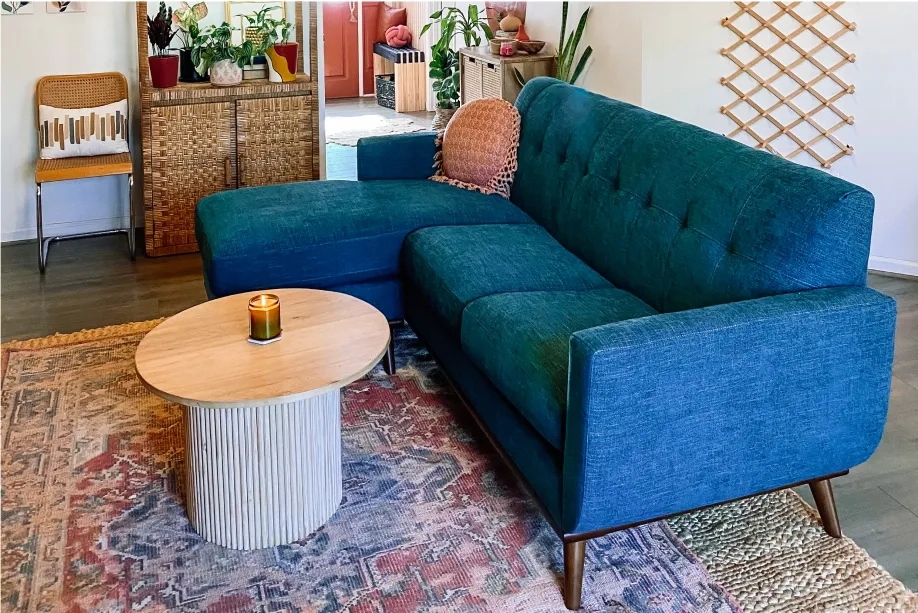
She serves mainly people who make a distinction
between commercial and non-commercial, Endres
says, and who want something unique.
"Her rugs are like snowflakes -- no two are
alike," says Realtor Jeannette Cook, another
longtime client. "The more you learn, the
more fascinating it is, all the different tribes
and how weaving is a part of their culture."
When Barbara Savage travels from New Jersey to
visit her daughter Dina Berger, she usually fits
in a trip to Endres' gallery.
"You just can't find these anywhere
else," says Savage, who has antique rugs in
each of her bathrooms and a number of other
rooms. "Everybody comments on my rugs."
What Endres enjoys is helping people understand
what they like and finding an appropriate rug.
She remembers her clients, the rugs they bought,
where those rugs fit and what will go with them.
She also knows her collection, choosing deftly
from the piles of larger rugs along the walls or
the smaller ones stacked on shelves to match a
client's previous purchase or new need. She's
even taken rugs back from customers when their
needs changed and they wanted something
different.
Because she personally buys the rugs, Endres is
familiar with the history and value of each
piece.
"I love her stories of what the symbols on
the rugs mean," Willis says. "She often
knows the people who made the rugs. It's like you
have something living."
Many of the rugs she sells were originally made
to keep, Endres says, not to sell. These pieces
of woven art are considered assets in the weaving
world.
Today, there are hardly any antique rugs still on
the market, and even newer, good rugs are harder
to find. But Endres continues to travel regularly
to weaving areas in the Middle East to carefully
choose rugs. The name of the business stems from
Turkey's "Silk Road," stretching from
Istanbul to Samarkand.
"Those years in Turkey gave me relationships
with people," she says. "The Iranians
and the Turks, if they like and respect you,
they'll give you special treatment."
The customers of Istanbul to Samarkand are the
real beneficiaries of that treatment.
MELISSA GASKILL is an Austin-based free-lance
writer.
Copyright 2000 American City Business Journals
Inc.
This article is reproduced here solely for the
purpose of furthering scholarly discussion in the
field of Oriental rugs and this use is protected
under the fair use provision of the US Copyright
law.
|